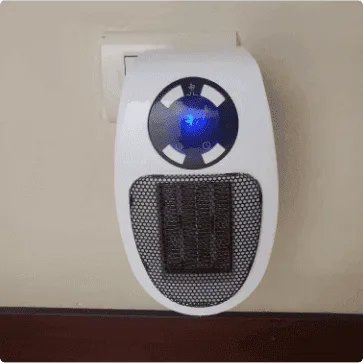
Ask ten people how to warm up a cold room and you will get three answers: turn up the thermostat, buy a space heater, or — more recently — get one of those small heaters that plug straight into the wall. Each is good at something different. Here is a clear look at all three so you can pick the right one for your room.
The quick answer
Use central heating to keep the whole house at a sensible baseline. Use a floor space heater for a large, very cold space where you need 1,500 W. For one normal-size room — a bedroom, office, nursery or RV — a 500 W plug-in wall heater with a thermostat is the cheapest to run, the easiest to live with and the one with no cord to trip over.
Central heating: great baseline, expensive for one room
The furnace or heat pump is the right tool for the whole house, and nothing here replaces it. Its weakness is precision: turn the thermostat up two degrees for the cold office and you have turned it up for the hallway, the kitchen and the empty guest room too. That is why the old advice is to lower the central thermostat and heat the room you are in some other way.
Floor space heater: powerful, but it owns the floor
The classic 1,500 W box or tower. It will warm a big living room or a garage, and that is its job. The trade-offs are the ones everyone knows: it takes floor space, the cord runs across the room, it is the thing children and pets bump into, the fan is audible, and at 1,500 W it is the most expensive of the three to run per hour. Modern units have tip-over switches for a reason.
Plug-in wall heater: made for one room
The newer category hangs the whole heater on the outlet: a ceramic element, a small fan, a thermostat and — on the better ones — a timer and a remote. At around 500 W it is sized for a single room up to roughly 350 sq ft, not a whole floor. In exchange you get a heater with no cord, no footprint, nothing to kick over, that costs about a third of a floor unit to run per hour and that you can carry to the RV in a coat pocket.
Side by side
| Plug-in wall heater | Floor space heater | Central heating | |
|---|---|---|---|
| Best for | One room up to ~350 sq ft | Large or very cold room | Whole-house baseline |
| Typical power | 500 W | 1,500 W | — |
| Cost per hour* | ~5–8¢ | ~15–24¢ | Heats every room |
| Warm-up | Minutes (fan-forced) | Minutes | Slow, whole house |
| Footprint | None | Floor space + cord | — |
| Trip / tip-over risk | No cord; tip-over cut-off | Cord; tip-over switch on good models | — |
| Noise | Quiet by design | Fan you can hear | Ductwork |
| Portability | Coat pocket | Carry by handle | — |
*At 10–16¢/kWh, full power. See how much a space heater costs to run for the math.
Which one should you buy?
- Cold living room or garage, big space? A 1,500 W floor heater, placed well away from anything flammable.
- Whole house too cold? That is a central heating or insulation problem, not a space heater problem.
- One bedroom, office, nursery or RV? A 500 W plug-in wall heater with a thermostat and timer. Cheapest to run, nothing on the floor, and you can move it to the next cold room tomorrow.
Our pick for one cold room
The plug-in heater we recommend is the Ultra Air Heater. It is a 500 W PTC ceramic unit that hangs on the wall outlet, rated by the maker for rooms up to 350 sq ft and about 5 cents an hour to run, with an LCD thermostat, a timer and a remote control. It handles the two safety jobs automatically: it reduces power and shuts down if it overheats, and if it is knocked off the outlet it stops heating, cools itself for 30 seconds and cuts the power. On the official site it costs $49 for one or $39.20 each in the three-pack, with a 60-day money-back promise.
Frequently asked questions
Are plug-in wall heaters any good?
For one room, yes. A 500 W plug-in ceramic heater with a thermostat is enough for a bedroom, office or nursery, costs a fraction of a 1,500 W floor unit to run, and has no cord or footprint. It will not heat a large open-plan space or a whole house.
Is a plug-in heater safer than a space heater?
The hazards that matter most with floor heaters — cords across the floor, units tipping over, contact with bedding or curtains — are reduced by design when the heater hangs on the outlet. Look for automatic overheat and tip-over shut-off either way, and never use a power strip or extension cord.
Can a space heater replace central heating?
Not for a whole house. Space heaters make sense for heating the one or two rooms you are using while the central thermostat is turned down. Heating every room with space heaters usually costs more than the furnace.