Space heaters are involved in a large share of home heating fires every winter, and almost all of those fires come down to a short list of avoidable mistakes. The good news is that the list is short. Here are the rules that actually matter, in the order they matter.
1. Wall outlet only. Never a power strip or extension cord.
This is the big one. Heaters pull more current than most power strips, extension cords, plug-in timers and adapters are rated for, and the weak link heats up. Plug the heater straight into the wall, and don’t plug anything else into the same outlet while it runs. If your outlet is in the wrong place, move the heater, not the rules.
2. Three feet of clear space
Keep bedding, curtains, clothes, paper, furniture and anything else that burns at least three feet from the front of the heater. In a bedroom that mostly means: not next to the bed with the duvet hanging off the edge, and not under a curtain.
3. Buy the two automatic protections
- Overheat shut-off. The heater should reduce power or switch itself off if its internal temperature climbs too high — because of a blocked grille, a hot room or a fault.
- Tip-over shut-off. If the heater falls over, it should stop heating immediately. On a floor unit this is a switch on the base; on a plug-in unit it triggers if the heater is knocked off the outlet.
A heater without both is not worth the discount.
4. Children and pets
Two problems: the hot surface, and the cord. Place the heater where small hands and paws can’t reach the grille, and route or remove any cord a child could pull. This is the strongest argument for a plug-in wall heater in a nursery: there is no cord, and nothing on the floor to tip.
5. Overnight use: let the timer do the thinking
Most manufacturers still say not to leave any heater unattended, and that includes while you sleep. The practical compromise most people land on: warm the room before bed, set the thermostat to a modest temperature, and use a timer so the heater switches itself off an hour or two after you fall asleep. You get the warm room when it matters and a heater that is off for most of the night.
6. Bathrooms and wet areas
Water and heaters do not mix. Unless a heater is specifically rated for bathroom use, keep it out of bathrooms, laundry rooms and anywhere it could get splashed.
7. RVs and campers
An RV is a small, well-sealed space with limited electrical capacity. An electric heater is a good fit (no combustion, no carbon monoxide), but size it small — a 500 W unit is far kinder to a camper’s circuit than a 1,500 W box — plug it into a wall outlet, keep the clearance rule, and never run it from the inverter’s power strip.
8. Keep it clean and check the plug
Dust on the grille makes a heater work harder and run hotter; a quick vacuum at the start of the season helps. Check that the plug fits snugly in the outlet — a loose, warm plug is a warning sign, and a worn outlet should be replaced before you hang a heater on it.
A heater designed around these rules
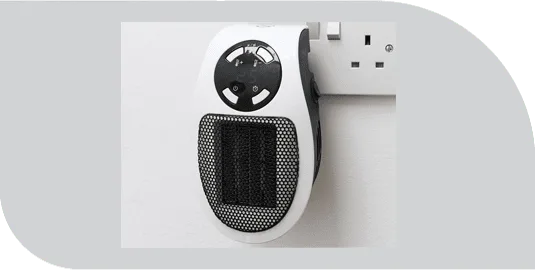
We use and recommend the Ultra Air Heater because it is built around the list above. It plugs directly into the wall outlet (no cord, nothing on the floor), its 500 W PTC ceramic element has no exposed coil, and the maker publishes both protections in detail: above 122°F internally it drops to 104°F and shuts down after three overheat events, and if it is knocked off the outlet it stops heating, blows room-temperature air for 30 seconds and cuts the power. The thermostat and timer cover the overnight rule, and the remote means nobody has to kneel next to it. The maker’s own instructions match this guide: wall outlet only, no bathrooms, don’t leave it unattended.
Frequently asked questions
Is it safe to leave a space heater on all night?
Only with a heater that has automatic overheat and tip-over shut-off, a thermostat, and ideally a timer, placed with clear space around it and plugged directly into a wall outlet. Many manufacturers still advise not leaving any heater unattended; a timer that switches it off after you fall asleep is the sensible middle ground.
Can I plug a space heater into a power strip?
No. Heaters draw more current than most power strips, extension cords, timers and plug-in adapters are designed for, and that is a common cause of overheating and fire. Always plug a heater directly into a wall outlet, and don’t share that outlet with other devices.
Is a space heater safe in a nursery?
It can be, with the right unit and placement: automatic shut-offs, nothing within three feet, out of reach, and no cord a child can pull. A plug-in heater mounted on the outlet removes the cord and the tip-over problem that floor units have.